

bierblog: equipment Archives
September 8, 2009
barrel aging in markham
barrel aged beers... they can range from the wild and funky beers of belgium to things like bourbon and brandy barrel aged beers in the US and everything in between. eric and i have been talking about doing some barrel aging for a while now, and have done a bunch of successful experimenting with oak cubes (plain oak in the oaked wee heavy, merlot + oak in the merlot stout, plain oak and bourbon + oak in parts of the breakfast brown ale, calvados + oak in half of the 2008 monk's elixir, and brandy + oak in the old toby), but the idea of using a real barrel is just more exciting.
eric got an old wine barrel from his dad, somthing like 10 gallons in volume, and we had aspirations to try putting it to use. however, after being dry for many years, we just couldn't get it to hold a seal. we spent days trying to tighten up the rings and filling it with water, but a few of the gaps just didn't seem like they were ever going to close. we figure we can still take it apart and turn it into a whole bunch of oak staves, but our quest for an actual barrel was still on.
we're fans of applewood, a great little winery just up the road in stoufville. they make some pretty awesome stuff using entirely fruit and honey from ontario. mead, port, ciders, fruit wines, and all sorts of other cool stuff. eric and i first made a visit to them on a saturday afternoon back in december '08. after chatting with Matt for a few minutes and mentioning brewing he immediately said "you aren't those hopocalypse guys, are you?". we got a bit of a laugh out of that and ended up staying and chatting with him until an hour after they'd officially closed for the night. we both walked out with a box of their stuff and i think some of it didn't even last the weekend.
since then we've visited a few more times and eric has talked with Matt via email. we've been looking at getting a barrel and since he regularly uses them, we figured he was a good resource about where to get them and how to maintain them. well, as it turned out Matt recently emptied one of his barrels, a 47 litre medium toast american oak barrel, and asked us if we could put it to use. the barrel has held one of his meads for the last year and we thought that could work well with a beer, so we jumped at the chance. Matt's only request was that we hook him up with the final result from whatever we put in the barrel. sounds like a great deal to me.
so in late august jenn and i dropped in, restocked on some iced apple liqueur and other treats and picked up the barrel. it actually still had a wee bit of mead still in the bottom and it smelled amazing. this was going to be cool!
back in october of '08, eric had a batch of his pumpkin ale that he put into a cask for sharing at chris+kyoko's halloween party, so i threw together a quick stand for it. as it turned out, that stand was a great size for holding the newly-acquired barrel.
now for what to put in it. we knew we'd need something higher-gravity to hold up to the barrel and the mead character. the next brewday was already planned out, so we didn't really have anything new to put in, but we did have a few beers aging in secondary. notably, we had my half of our most recent old ale and russian imperial stout. we both immediately thought of firestone walker and their anniversary beers, which are blends of several barrel aged beers. we figured that both the RIS and old ale would work well with the barrel, and would get us most of the volume we'd need to fill it. eric and i decided we'd put them in and just split his previously bottled half of each batch. we also had the gonzo clone ready to go to secondary, so we used some of that to top it off and dry hopped the rest.

the first problem was how to fill the barrel. to siphon we needed to get the fermenters up higher than the barrel, so we improvised with some wood i had in the basement and one of our brewing pots. looked risky, but did the trick. sounds like a good reason to finally build a rig for moving beer with co2.

eric posing as the first thread, the old ale, starts going in.

a little closer view.

my turn.

second thread, the ris, going in.


checking the fill level as we approach the end of the RIS. it was already smelling pretty damn good.

the barrel, full and ready for a long rest.
so now we just wait. it smells pretty excellent right now. we're going to check on it from time to time and see how it progresses. we also thought it would be neat to add a little of every beer we make between now and whenever we bottle it. you likely won't taste the other beers, but it'll be neat to know that we've got something like a year's worth of beer going into the barrel. we'll keep you posted on how it progresses.
March 29, 2009
first markham brewday of 2009
since we started brewing here in markham, our final brewday of the year has been one or more big beers designed for aging, sort of our "vintage ale". in 2005 we brewed an imperial stout and our rochefort 10 clone [brewday blog]. in 2006 we made our first old ale [brewday blog]. in 2007 we made another old ale [brewday blog], this one with an american slant. to finish 2008 we had planned both an old ale and a russian imperial stout based on the recipes from 2006 and 2005 respectively.
another common thread with these brewdays is cold. the 2005 brewday started out with snow on the ground and got colder as the day progressed. the hoses froze, it took forever for things to reach temperature, cleaning was a pain, and the day seemed to go on forever. this prompted me to swear i'd never brew again in sub-zero temperatures. 2006 went a little better - although the brewday was in early december the temperature stayed above freezing and the day went smoothly. 2007 was not as good. it started off well below freezing and never really got better. however, we had built up a couple of giant starters and knew we wouldn't get another chance at it, so we went for it. what a nightmare. the hoses were completely unusable. every bit of spilled water turned instantly into a sheet of ice. it made every aspect of the day more challenging and a huge pain in the ass. by the end of the day we decided that even if it meant sacrificing yeast, we'd definitely never do it again.
so late 2008 rolled around, and we started planning for our final brewday. in preparation for it, we brewed up an ESB and a stout [brewday blog] to generate nice fat yeast cakes for our old ale and russian imperial stout. however, as the brewday approached the weather was looking ugly... much like 2007 the temperature wasn't going to reach above the freezing mark. we decided to save as much of the yeast slurry as possible and hope for another warm weekend. as it turned out, we didn't see one until the spring of 2009...

the garage in "winter mode": all the gear piled high in the back corner, table collapsed on the wall, and room for the car to fit inside.

brewday breakfast: smoked salmon, berries, bagels, and two kinds of homemade cream cheese. sweet! on yeah, and the always important coffee.

i made a couple small modifications to the mill this year. i decided it was a hassle to use a bucket and it'd be more convenient to just mill straight into our kettles. i figured i could just use a clamp to hook the handle of the kettle on to the top of the mill. so i took off the leg and attached a piece of jean leg to direct the milled grain down into the kettle. works like a charm!

strike water coming up to temp.

eric weighing out the grain. since we more than killed a full bag of malt, we figured it'd be easier to just weigh the specialty malts inside and take care of the rest in the garage.


the newly modified mill. works on any kettle size too!

another view of breakfast.

freshly milled grain! i think this was the old ale.

the sugar we decided to use in our two batches. the thai palm sugar went into the old ale and the sucanat sugar went into the stout.


eric filling up the bucket tun with the "high" mash for the stout. damn that shit was black!


finally got around to slotting the manifold for our second cooler tun. the first shows it freshly slotted. the second shows it after i cleaned it all up. the third is a closeup showing it nice and smooth.

the two tuns for the ris.

vorlauf of the "high" mash. i think this is about when we started calling the beer black death.

adding the sucanat sugar to the first runnings on the stout.

can you say black?


second tun ready for its maiden voyage.


magic elixir getting angry, just the way we like it!

the main stout wort on its way to a boil.

another shot of the elixir. it had boiled down a fair bit by this point.

eric putting up the horns for the blackness of the stout.

both batches now on the burners and ready to go.

hops for both brews.

refractometer and promash.

the final result of the magic elixir. it had boiled down from around 4 gallons to about 1 gallon. you can see the carnage on the sides of the pot. beside it is the spent grain, ready for composting.


both batches rolling along. the stout was boiling and the old ale was almost there.

eric adding some of the magic elixir back into the main stout wort. we waited until we had a little boil off, then started adding it a little at a time so we wouldn't kill the boil.

old ale now happily boiling away.

stout chilling and old ale boiling.

the stout on its way into the fermenter. yep, still black as hell.

and now the old ale too.
another successful brew day.
July 21, 2008
saison time + new gear
saison is a style that i've been interested in brewing ever since the first time i tried one. it's an interesting and very broad style. after reading farmhouse ales i was even more interested.
with such a broad style, there were so many places that i could have started. as luck would have it, i was browsing the homebrewing forum on beer advocate when i ran across this posting by SV650TN that caught my attention. i used his recipe as a base for what i later dubbed the Dirty Ape Saison in his honour.
eric had also been working on an idea for a "black saison", basically a typical saison recipe but adding in dehusked carafa iii and special b malts to give it a darker colour without the roasty or astringent character typically found in stouts and porters. he dubbed the final recipe Saisons In The Abyss.
this is a style that usually needs to be fermented on the warm side, not really at the sort of temperature i can maintain in the house. i decided the best solution would be to ferment it in my garage. last year we didn't manage to find a time that matched well with the weather (always was either too hot or too cold), so it was put on hold until this year.
i waited through the spring and knew that if i wanted to make them i needed to do it now (mid july) before it got too hot in august or too cool beyond. during the week leading up to the brewday i was a bit nervous as temps were in the 95F range, but i was hopeful that it wouldn't last. as luck would have it, by saturday the temp was falling a little (though still very humid) and the forecast was for the humidity to break and for temps to ease off to about 80F, right where i wanted.
first up, some new equipment.
i've long wanted something larger and more durable than our existing glass carboys, at least for primary fermentation. years ago we considered putting a lid on our boil keggle and fermenting in it, but we never got it to a point where we were happy with the seal or lid. however, i recently found this page describing how to turn kegs into fermenters. i was convinced that i should be able to do something similar.
i got 4 50L/13gal kegs over the winter with intentions of turning two of them into fermenters and the other two into keggles. scott found them online and shared them with the rest of us. since he also works at a welding shop, he had a friend and coworker cut the tops off with a plasma cutter. i had the two fermenters cut with an 8" hole - big enough to get inside and clean them yet small enough that i could put a lid on. i had the other two cut with a standard 12" opening and also had a bulkhead welded in.
first up was the fermenters. i picked up a 2'x4' sheet of 1/4" acrylic and cut a pair of 10" diameter lids. a 36" piece of 3/4" steel box tubing would be used for the brace on both lids. some washers, nuts, and o-bolts would hold it all together. some 1/8" tubing would be used to make a rough seal.


i took the 1/8" tubing and slit it open lengthwise. i then used that to cover the cut edge of the keg top. i initially tried to seal the two ends together with some silicone sealant, but it didn't quite work. even without that it formed a fairly decent seal. here you can see the (still dirty) keg with the tubing in place.


these two show the brace that will hold the lid in place. i had to notch out the ends since i didn't have clearance to slide the full bar under the handles along with the nut+washer+lid. this didn't seem to change the strength in any noticeable way - it's still much stronger than the acrylic would be if put to the test.
i chose a washer that sits on the end of the bolt, so the lid will be protected from the bolt. the O is purely for ease of tightening and a plain old bolt or wing nut would probably work just fine too. this was an easy and inexpensive option.
i didn't bother with trying to tap the steel bar and just got a bolt that sits on the bottom. over time the threads on the bolt might get worn down, but i have a feeling it'll last more than long enough.

here you can see the two lids with a 1 1/4" hole cut for an airlock/blowoff. they still have the protective paper on both sides.


this shows how the lid would be assembled. the longer slotted end is inserted first, then slid over until the other end is in place. the nut and bolt are tightended until the lid is snug and secure. you'll see this in action later...

you can't quite tell with the glare, but i was trying to show how i protected the lid from the bottom of the washers. the link above suggested using a piece of rubber. i made it easy and just stuck on a piece of duct tape and cut around it. that should do the trick.

you can't quite tell, but i was trying to show how i glued the two ends of the 1/8" tubing together with silicone. alas, as soon as i tried to remove it from the keg it fell apart. i might try melting the ends together, and failing that i'll just leave it unattached.

the shiny new bulkhead+valve on the keggle. 1" long 1/2" MTP brass nipple, 1/2" FTP stainless ball valve, and 1/2" MTP to 1/2" brass hose barb.
fatal flaw that would become apparent later: not using teflon tape on the connections.

inside view of the keggle. the pickup tube is fairly standard. 1/2" MTP to 1/2" copper connector, a couple pieces of copper pipe, and an elbow. you can also see my atypical false bottom - more on that in a moment.

here you can see the bulkhead+valve on the second keggle. notice how i had to turn the valve upside down. the vent hole just to the left of the bulkhead would have had way too much heat going upwards and melted the handle on the valve, so i flipped it this way. ideally the vent would be nowhere near the valve, but in this case it was too late.

a closer look at my false bottom. usually these are flat, sometimes hinged, perforated steel plates that cover the whole bottom from wall to wall and sit fairly high. the other approach is to use something like a bazooka tee - a screen tube attached to the pickup.
scott had hooked me up with some perforated stainless steel plate, but it was only about 11" wide, so if i wanted to cover teh whole bottom i'd definitely need to figure out a hinge. the other reason it'd need a hinge is that the opening on the keggle doesn't go right to the edges. i thought a dome or cone shaped bottom with an 11" diameter would work pretty well and also be small enough to fit through the 12" opening.
i made a cardboard template 11" across, then transferred it to the steel plate. i used the grinder with a stainless steel cutting wheel to cut out the circle, then made a slit to the center. this is pretty sturdy stuff, so i had to use the holes to pry the two edges together, holding them in place and then beding a little more. a couple of screws helped to hold it all together. i then a dremel with a fiberglass reinforced cutoff wheel to trim out the center hole just big enough for a copper pipe to fit through.

here you can see the pickup tube that i made. this sits flush with the bottom of the keggle, which is why i made some slots in the sides to allow wort in.
the extra piece is a 3/4" couplr that i modified so it'll slip over the end of the tube. this helps to hold the false bottom snug on the bottom of the kettle.
i'm going to solder the left hand end into the 1/2" MTP adapter that screws into the bulkhead, and also the downward side of the elbow. the other connection will be left unsoldered for assembly. it's common to leave this joint open and cut a notch in the elbow, using a clamp to make sure it's snug. so far a friction fit has worked out well enough for me.

this shows it assembled as it'd look in the keggle. it fits pretty well to the bottom, with enough surface area to collect most of the hops and trub yet still allowing the wort through. i have all the parts and need to make one for the second keggle.

me figuring out strike volume/temp and taking photos of the new gear.


jenn and jan ran out to pick up propane, sugar for the saisons, and supplies for lunch. they also returned with this net+ball thing that eric were using here...

...and this inflatable centepede sprinkler.

jan stirring the mash on the dirty ape saison. it was pretty hot and humid, so it didn't take long for jan+eric to lose their shirts.

me about to dough in the black saison.


the temp on the black saison was a bit low, so we threw it back on the heat. here you can see eric using the mini-paddle that scott made.

me and the boys. i'm rockin' my new hop-and-crossbones shirt from homebrew tees. this might seem familiar, as i've been using it as my avatar on beer advocate and other sites and also as the unofficial logo for our hopocalypse ipa.
you may remember my homebrewer shirt from them being featured in past brewday blogs. after ordering it and talking with chris/oxmasterscream, we got to talking about other shirt designs. he has some other cool designs in the works. we talked about using my hop-and-crossbones design for a shirt, which seemed like a great idea. i had always thougth it'd make a great shirt, just hadn't got around to having some printed. this meant that i wouldn't have to bother and more people would get to enjoy them. so help out a fellow homebrewer and order one from chris today!


jan posing it up...

...and weight lifting with the keggle.

eric getting ready to sparge the black saison.

jan cleaning up the new ported keggle.

eric cleaning up the keggle and getting ready for collection of the black saison.

adjusting the flow rate on the black saison. this one started running pretty slow due to the dehusked carafa and the wheat, but we managed to collect the expected volume before it jammed right up.

vorlauf on the regular saison and the keggle assembled and ready for action.

the saison mash during vorlauf.

the black saison looking pretty black.

sparging the saison on the left. on the right is jays' most recent edition of the pineapple ale. this time he fermented it with a kolsh yeast, which seems to have worked out really well. quite tasty!


both beers cooking away. the black saison on the left was already boiling, and the regular saison was almost there.
at this point you might notice that this is our old standard keggle and not the shiny new one with the false bottom and ball valve. remember that comment above about teflon tape? well when the keggle was about half full i noticed that there was a very slow leak from between the bulkhead and the ball valve. i tried tightening it up, but it actually seemed to make it leak worse. i left it alone until we were done collection and then transferred the wort into the old keggle.
the good news was that the pickup tube worked like a charm, leaving almost no wort in the bottom. i've since taken it back apart and will be reassembling it with some teflon tape this time...

one of the new fermenters (since we only needed one today) cleaned, sanitized, and ready for action. i dumped in some sanitizer and sealed it up, then rolled it around for a few minutes. i turned it upside down and let it drain out and covered the airlock opening with a piece of plastic wrap.

the black saison in the fermenter.


the dirty ape saison transferring into the new fermenter.

"you ain't cool unless you pee your pants."

jan popping into frame.


"i added dice and the disco ball"

jan posing again.

the beers already looking pretty happy, with blowoffs installed.


the end of another successful brew day. harviestoun ola dubh 12, 16, and 30 ready for sampling.

jan excited about the 12.

me playing with the foil wrapper and ready to open a beer.
August 27, 2007
new gear in markham
when we setup our brewing operations at my place in markham, most of the equipment came from my apartment-bound biergotter bretheren, mostly DrJay. when a new job brought him down to philly he left most of it here since they were still in an apartment. when they bought a house earlier this year, i knew jay would be setting up the first US biergotter contingent. that means it's time to build some new gear!
the first order of business was a new chiller. we'd been unhappy with the old 25' chiller for doing 10gal batches, so were already interested in going up to 50'.
next up, we needed to replace jay's cooler tun. i caught a sale at walmart and grabbed a pair of 48qt coolers. picked up the copper for the manifolds and got everything cut to size the other night, so the only thing left to do was cut the slots in it.

there's me with my sweet tee from homebrewtees.com. chris (oxmasterscream on beer advocate) is a fellow homebrewer and puts these together on the side. check them out!

you can see a little better in this photo, but i was trying to move the stupid pipe bender. sure, these things are great for making sure you don't kink the soft copper when you're bending it, but goddamn are they a pain in the ass. put even a slight bend and they start binding up and barely move. after the first two bends we gave up, then spent the next 20min trying to pull the damn thing off. more time was spent trying to remove it than bending the whole coil (which went flawlessly around a corny). more trouble than they're worth.


here i was showing eric how to use the dremel to cut slots in our copper manifold for the coolers. not much to see really.

now we have eric working on the manifold in the background, and jan working on a beverage. can't quite remember what it was at this point.


eric hard at work.


i managed to get a metal sliver, but it was easily removed.

the first two bends on the new 50' chiller.

another shot, also showing the associated hose, two coolers and the second manifold.


the chiller, nearly done. i attached a few pieces of twine to temporarily hold things together and later switched to some copper wire.

eric posing with the new hardware. check out my next entry for some shots of the completed chiller in action.

another shot of the coolers + manifold.

progress on the manifold.


one half done, onto the other.

had some tasty oskar blues gordon and were just about to open a heavyweight lunacy. both were quite tasty.

jan took over and finished the second half of the manifold.

on to dinner and some sampling. tasty steak sandwiches (with cheese and carmelized onions), salad, deviled eggs, and fresh tomatoes from our garden. i'm pretty sure we were drinking the weihenstephan 1809 berliner weiss.


jan had recently returned from a trip to belgium and brought back a ton of excellent beer. here i was opening the first of three bottles from girardin, their 1882 faro. later we also had the 1882 gueuze white label (filtered) and the 1882 kriek. after that we moved on to a bottle of bar harbor cadillac mtn stout. great stuff!
a successful day working on some equipment, great dinner, and some excellent beers. does it get any better?
June 7, 2006
motorizing the barley crusher
if you read my entry about raising the edmund fitzgerald, you know that i've recently purchased a shiny new barley crusher. well, long before i bought it i also had plans to motorize it.
as with all home-made homebrew gadgetry, my first stop is always Mike Dixon's webpage. can't say enough about Mike. he's always active and helpful in the homebrewing forum on beeradvocate, and his webpage has tons of useful info. a quick look down the page and you'll find a page detailing motorizing a malt mill and building a larger hopper for the grain, including a link to an article he wrote in HBD that tells you everything you need to know to motorize a mill, including all the math for getting the right RPM and selecting sheaves and belts. i'm basically just copying info from there, with the numbers changed to reflect the parts i used.
first order of business was a motor. this fall one of my neighbours was getting rid of their furnace, and one of the items that was sitting at the side of the road was a nice electric motor that i knew would work great if it was still functional. it also had a couple of sheaves, and i figured that at least the small one would be useful for my purposes. i stopped at the local hardware store, grabbed a dimmer switch, box, and an extension cord, wired it all up and plugged it in. as i slowly turned on the dimmer switch, the motor began to hum and sprang to life. free motor, excellent!
Grainger is a great resource for all the parts for this project (and lots more). on a recent trip to Minnesota i dropped in to one of their locations and picked up everything i needed for this project.
according to the website, the barleycrusher says it can do 500rpm. my motor is the typical 1725rpm and has a small adjustable sheave is 3.5" with 3.25" pitch diameter maximum and should go much smaller. so with 1725rpm motor and a max of 500rpm on the barleycrusher i know i'd need a sheave pitch diameter ratio of at least:
1725/500 = 3.45
so if we assume that my small sheave is 3.25" that means that the large sheave would need to be:
3.25" x 3.45 = 11.2125" pitch diameter or greater (with existing 3.25" wheel)
so checking out grainger i found a 12" sheave that looked like it'd work. figuring out the exact speed of the mill based on these two sheaves:
12"OD sheave has pitch diameter of 11.85". 1725rpm * 3.25"/11.85" = 473rpm
under 500rpm as expected. great! i also figured out that if i adjust the small sheave so it has a pitch diameter of 2.75" i'll drop the speed even further, to 400rpm. better to be safe, so i figured i'd go for this.
however, the 12" sheaves have an internal diameter of 1/2" and the barley crusher has a shaft that's 3/8". fortunately grainger also has bushings, and the 3/4" to 1/2" bushing would be perfect. the only tricky bit that i had to do was slightly modify the bushing. it's "C" shaped, but the opening wasn't wide enough for me to tighten up the bolt in the 12" sheave. i pulled out my trusty dremel and was able to trim the bushing, widening the opening enough that the bolt to fit through and allowing me to tighten it up on the shaft.
now, to figure out the size of belt i'd need:
center distance of shafts must be > 8"
C = (L - 1.57(D+d))/2
C = (L - 1.57(12+3.5))/2
C = (L - 24.335)/2
C = L/2 - 12.1675
40" length: C = 20 - 12.1675 = 7.8325" (too close)
50" length: C = 25 - 12.1675 = 12.835" (good)
so a 50" belt would be great. again, grainger sells a 50" v belt that would be perfect.
with that i had all the parts i'd need and set to motorizing the mill.

the large sheave and the belt. you can also just barely see the sheave inserted in the center of the sheave.

laying out the pieces and figuring out placement. when we replaced our kitchen countertop recently i saved the piece cut out for the sink. perfect for the base of the mill. another great idea from Mike.

after marking/drilling the placement for the new barley crusher base plate. there's two outer holes to anchor the mill down, and the four corner holes that were used to cut out the exit hole for the grain.

here you can see the barley crusher fitted in place with the sheave attached, and the slots made for anchoring the motor. there's lots of room to move the motor in case i end up switching to a different size belt or need to tighten/loosen it.

the motor, mill, and power all hooked up. now it needs something to sit on for general use.

after flipping over the entire setup i positioned and traced the outline of a bucket. i then took the three bucket gides from the original barley crusher baseplate and transferred them to this one to help hold the bucket in place.


two shots of the underside of the mill. you can see the outline and the position of the guides. i positioned the first one so that it'd also support the leg when closed (more on that below)

the other end of the baseplate. i screwed on a small piece of wood to raise up above the bolts that are holding the motor in place.

then i made a leg so that it'd sit level when the oposite end is resting on a bucket. it's hinged and attached to the piece shown above, and when closed like this the opposite end rests on one of the bucket guide pegs as mentioned above.

standing on its end. notice the chain i added to make sure the leg wouldn't get over-extended.


two shots of the finished motorized mill, one from each side.
so far the motorized version has been used for one brew day. it took us all of 15 minutes to weigh out the grain for the two batches (18# and 16#) and grind it all. that's pretty damn good when you consider that we'd normally be at this for a couple hours of manual grinding with the old corona mill (as seen here).

making a mash paddle
i've been searching for a good stainless steel mash paddle for a while now and not having any luck. i found a couple, but they were always far too small and not nearly strong enough to try and stir 30 pounds of grain when mashing. we previously tried plastic, but when we were pretty much bending it in half it made us nervous. for a while now i've been using a broom handle, which is definitely big enough and strong enough, but doesn't really stir a mash that well. so when i saw this post on beeradvocate about another homebrewer considering making his own mash paddle i was quite interested. a nice hardwood mash paddle would certainly do the job, and i could make it any size i liked.
there were a couple of links given in the thread on BA (this one showing a fairly simple design that's a bit smaller than i was thinking and this one [link to http://www.hopsdirect.com/spotlight/9903/ is dead, but still available courtesy of the wayback machine] that showed some larger and fancier designs and talked a bit about wood types). that pointed me in the right direction. a bit more searching found several more (1, 2, 3, and 4). so i had some good ideas.
i figured that buying a big piece of suitable wood would be expensive, but a quick trip over to my local lumber store and i had a 4'x6"x1" piece of red oak for just over $20. not bad at all!
i decided on a rough design and did a full-size drawing on paper, making a few adjustments until i thought i had what i wanted. (i'm going to add a printable PDF here eventually in case anyone would like to do the same. if you're interested, drop me an email and i can give you the measurements or something). Edit: here they are, just make sure you print them at the original size and don't use any scaling:
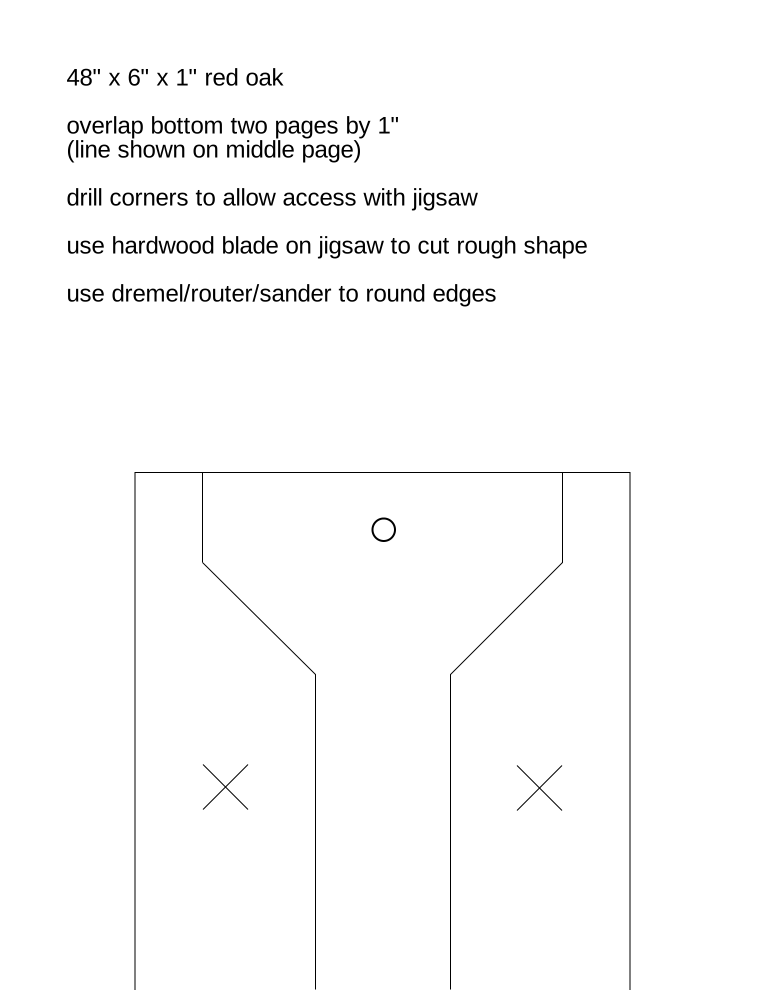
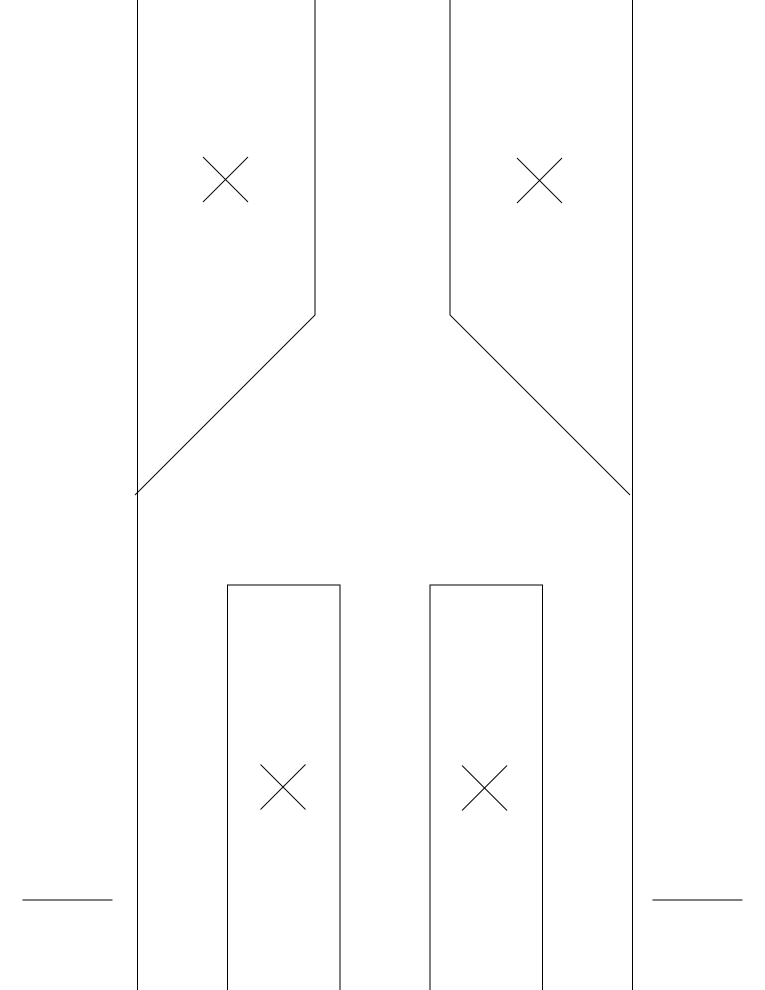
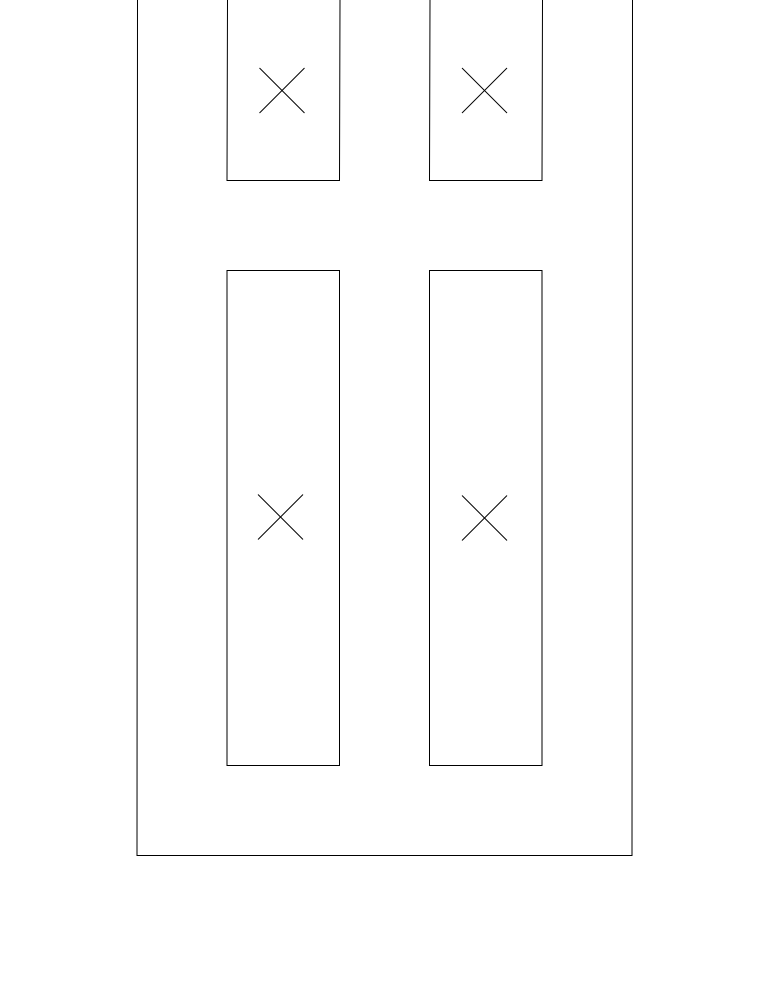
unfortunately, i didn't think to grab my camera until i was done making the paddle, but i still had the scrap pieces around so i took a few photos to give you the rough idea.

the whole thing, layed out as before i started cutting.

a closeup of the bottom end of the paddle. initially i made large holes at each corner. for the inner holes you can see that i tried to make two of them beside each other, but it was quite a pain in the ass, and really unnecessary. the large holes were not really necessary either. i made smaller 1/4" holes in the opposite corner of each section and it was enough to get my jigsaw in and around the corner.

the top end of the paddle, with a nice handle that makes it easy to control and a hole so that i can hang it up when not in use.

closeup of the finished bottom end of the paddle.

and the top.

the finished paddle hanging on the wall in my garage, waiting for the next brew day.
the basic procedure i used was to draw the design out on the wood, drill pilot holes in the corners (5/8" for the big ones, 1/4" for the small ones), then use a jigsaw with a blade designed for hardwood to cutout the four center pieces and the two sides. once i had the basic shape cut out i tried using my dremel to do some rough shaping and sanding. i found that the small tool size made it difficult to get a nice even finish to the edges, so i switched to a belt sander. the belt sander made quick work of rounding out all the edges, but didn't work very well in the corners. i went back to the dremel to clean up the edges and the parts where the beld sander couldn't reach (like the four inner holes). i used a foam sanding block to smooth everything out, then switched to a piece of find grit sandpaper to finish things off, concentrating on making sure the handle was nice and smooth.
we've used it for two brew days so far, and it's working wonderfully. i'm quite happy with it and have completely forgotten about my initial search for a stainless paddle.
January 31, 2006
cutting a keg kettle
I've seen descriptions of how to cut the top off a keg for use as a brew kettle, but never one with lots of detail or photos of the process, so when i made our last one back in november i took photos along the way. enjoy.

here's the uncut keg with the line drawn for cutting. Take a piece of string and loop it around the center post in the keg. then grab a sharpie and put it in the other end of the loop. rotate around the post to make a nice circle for cutting. We made the hole the same size as the top on one of our 5 gallon pots, which turned out to be 12 inches, so that we can use the lid on the keg too.
to do the cutting we've been using my dremel with fiberglass reinforced cutting wheels. The regular disks just disintegrate too easy. The fiberglass onces will still wear down if you try to go too quickly, but with patience you can get the keg cut with only a couple disks.

starting the first pass. Don't try to go all the way through right away or you'll burn through the cutting disks in no time. make a first pass about half way through to "score" the cut first. you can see the cut starting towards the bottom and going about 1/4 of the way around clockwise.

bit closer shot. you can kind of see that i'm not going the whole way through yet.

now i've gone the whole way around and i'm starting the second pass, cutting the whole way through now.

same thing a little closer.

this one shows that i'm almost done, just a little left at the bottom to finish.

now that the hole has been cut, it's pretty jagged and sharp around the edges. switch to a sanding wheel and clean that up so that nobody gets hurt.

the finished product after sanding the edges down. you can see all the bits of metal and some water in the bottom. One thing that i didn't do when i cut the keg is fill it mostly full of water. i've heard that this greatly helps deaden the sound of the dremel, which is pretty damn loud. i'll know that for the next time i need to cut a keg...
so that's it. all it needs is a good washing and it's ready to be used as a kettle. you can optionally install things like thermometers and drainage valves, but we just use them like this and siphon liquids out.
© 2005 Bierg�tter Homebrew Club. Disclaimer.
Last Modified:
Saturday, 30-Jun-2018 08:44:55 MST