All posts by grub

wee heavy + coffee porter mayhem!

today was another brew day. the plan for today was two follow-on batches using the yeast cakes from the “single malt scotch” ale: an oaked wee heavy (our first time using oak) and eric’s project, a clone of Hair of the Dog‘s Fred. unfortunately, eric is having more back troubles, and between that and scheduling issues he wasn’t able to come out today. so i threw his half of the yeast cake in the fridge for later use, and decided to go ahead with the wee heavy. eric also recently graduated and has joined the “real world”. i don’t think he’s enjoying the schedule as much as student life ;)

since none of the biergotter regulars were available, i asked taavi if he’d like to come out again for the brew day. that’s when he let me know that he’d recently got engaged and asked if i’d consider making all the beer for his wedding. i congradulated him and said that it would be an interesting and fun project. since the wedding is scheduled for august of next year, we had lots of time to decide on recipes and do some trial batches. i think that the bulk of the beer will be something along the lines of our pale ale, but we’ll probably also do a batch or two for those with more “educated” tastes. when i asked about what sort of things he likes to drink, the first thing he mentioned was mill street‘s coffee porter. as i love almost all things porter, including mill street’s porter, and i’ve long been considering trying a coffee porter, i was definitely interested. i started with our sweet johnny porter and came up with what i’m currently calling java johnny porter. it’s a fairly straight robust porter, but i’ll be cold steeping some coffee and adding it at bottling time. delicious!

the day started around 9:00am. i went out to the garage to set things up for the brew day and found that almost everything was covered in a layer of dirt, shingle bits, and wood chips. we had our roof redone yesterday, and it appears that all kinds of crap rained down when they were stripping off the old shingles. maybe it’s only really an issue since our roof was definitely past its prime. taavi arrived at about 9:30, which turned out to be perfect timing as i’d just finished cleanup and had started weighing out the grain for the two batches.

the other change for today was no more protein rests. so far we’ve been doing them with all of our all-grain batches, but as i’ve learned more i don’t think it’s necessary. these days malts are very well modified, so in general there’s no need to do a protein rest. i tested this out on our last brew day, skipping this rest for the pale ale v2. it turned out just as good as the previous run and we had no problems with efficiency either.

our usual brew day procedure is heat up 1 quart of water per pound of grain to 130F, mix well, and when we’re not at 122F we’d heat it to reach that point. this would rest for 30 minutes. then we’d boil 1/2 quart of water per pound of grain, add that and then heat it until the grain is at the desired temp for the saccarification rest (150F-160F) and rest there for an hour. with the last brew of the pale ale, i did the same thing, but without a rest between adding the 1 qt/lb at 130F and adding the 1/2 qt/lb at boiling. that worked out ok, but is kind of annoying. this time i decided to try out a feature in promash that i’ve never used before, the strike temp too. this thing is pretty cool. i stuck in the mash tun thermal mass (i used 0 as a first try), total grain weight, water/grain ratio or total water, the desired strike temp, and the current grain temp. i did this for the two batches and when i did the dough in both batches exactly hit their target temps for the sacc rest. this was much easier (and faster) than our usual procedure.

started both batches pretty much at the same time, with the sacc rest for the wee heavy starting about 15min before the porter. i wanted to run them pretty much in parallel to minimize time for the brew day, but then realized that the one thing i can’t do in parallel is chilling, and with the extra 30min on the boil of hte wee heavy, i’d have them finsihing at almost the same time. however, that didn’t account for differences in the time to sparge both of them. the smaller grain bill on the porter and the bucket tun made the grain bed set quickly and the sparge on this one was done quite fast. actually ended up with the porter reaching a boil 30min before the wee heavy, and with the extra boil time on the wee heavy it meant we ended up with an hour between when the two would finish. just enough time to chill the porter, transfer it into the fermenter, and get ready for the second batch.

when the yeast was pitched and everything was cleaned up it wasn’t even 5:00pm yet. pretty good for two batches.

on with the photos!

the barley crusher tearing through some grain. man i love this thing. best brewing investment so far.

the wee heavy grain, waiting for dough in.

water for the wee heavy rising towards the target of 167F.

jenn came out to say hello and checked on the water for the porter.

exterior view of the new bucket tun, for use with “small” batches (under 15#).

interior view of the tun. the manifold is a ring of soft copper tubing with slits cut about every quarter inch, then a small piece of tubing joining it with one end of the hose barb. the other end of the hose barb goes out through a hole in the side of the bucket and has a hose attached for collecting sweet sweet wort. there’s also a few pieces from the old cooler manifold, which finally died after the last batch. one piece raises it up off the bottom of the bucket, the other lifts it and helps push it away from the side, closer to the center of the bucket.

the new copper manifold for the cooler. the two pieces in the center are scraps that are used for positioning the manifold in the center of the tun and raised up off the bottom.

that’s me positioning the new maifold in the cooler. the first piece of copper tubing is used to lift it off the bottom of the cooler and help keep the rubber stopper in place.

final position of the tun. there’s an elbow and small piece of tubing on the upper left end to hold it away from the side and off the bottom. the outlet is actually hidden at the lower right end of the photo.

that’s me again, this time checking on the vorlauf of the porter. already nice and clear!

collecting the sweet sweet wort for the porter.

and collection for the wee heavy.

close up view of the porter. note the adjustable wrench on the right hand side of the image. picked up this tip from one of the guys who sent us an ask biergotter message. richard dropped us a note and tim and i went out to visit one of his brew days. we sampled some of each other’s beers and traded stories. when i first noticed him using an adjustable wrench to control the flow from his tun i thought it was a little odd, but then i tried it out and it’s great. hose clamps never seem to stop in just the right spot, but wiht the adjustable wrench you can set it to exactly where you want.

close up on the wee heavy too. another adjustable wrench in use here too.

promash and lunch: sausages, munchos, and the resurrection of the edmund fitzgerald. damn this stuff is good!

hops ready for addition. on the left is the 15min and 0min fuggle additions for the porter (60min addition of northdown had already gone in), and on the right is the 90min northern brewer addition and 10min fuggle addition for the wee heavy.

the porter, happily boiling away.

the wee heavy, not quite boiling yet.

shinny copper manifolds!

the porter heading into the fermenter. taavi looks like a proud father with his first beer.

damn your eyes, porter!

the remains of the scotch ale. about a half gallon of beer and a whole lot of yeasty goodness.

the wee heavy heading into the fermenter.

post brew day carnage. 3 kegs in front, one of the two propane tanks, cooler tun, two burners and extra grain under the table, two 5gal pots and one 10gal pot, bucket tun, bin with all the odds and ends.

both batches in the fermenters. porter on the left and wee heavy on the right.

next up: rob and i will be brewing up 10 gallons of an arrogant bastard clone. chinooky goodness!

better late than never

couldn’t decide what to call this entry, but since i’ve been procrastinating putting it up for over a week, this one seemed appropriate.

so june 3rd was another biergotter brew day. tim and eric came out to my place bright and early. the plan for the day was two 10 gallon batches. the first would be a rebrew of the pale ale that i brewed a few months ago, pale ale v2.

the second batch was an experiment that i’ve been considering for a while, a scotch ale using peat and smoked malts and using some oak, taking some of the character from my favourite single malt scotches and applying that to beer. since none of us has worked with smoked malts or oak before, we decided to simplify things a bit and save the oak for another batch. after a bit of research i came up with the recipe for v1 of the “single malt scotch” ale.

up in the toronto area (really, all of southwestern ontario) it’s pretty hard to find any good hombrewing supplies. tons of wine shops, but no good beer shops. as a result, it usually means when one of us is in windsor we’ll make a trip over to the detroit area for supplies.

after reading this post on beeradvocate about a place called “Adventures in Homebrewing” selling corny kegs for $13, i started looking for their website. sure enough, within a few minutes google had pointed me to the Adventures in Homebrewing website. poking around on their site i found that they had much more than just good deals on corny kegs (which are now $15, and still a good deal). I emailed them and got a quick, friendly reply from Jason. then eric emailed him to get a kegerator setup, and jason hooked him up too. i was initally planning to hit there for hardware and make another stop for ingredients, but i was able to find just about everything i could imagine at their shop, so i just went there.

with the recipes in hand, i made the trip over to detroit to check out a adventures. As Jason had told me, Matt was working when i arrived. he was just finishing up eric’s order and was very helpful as i gathered up all of the stuff i needed. tim also decided to go with the same thing that eric was getting, so Matt worked on getting everything for his order. they were even nice enough to assemble the towers for us (and watching him do it, i’m glad: it looked like a pain in the ass).

so i’d be happy to recommend Adventures in Homebrewing to anyone in the detroit area looking for a LHBS, and also to anyone looking for a good place for mail order. can’t beat the price of those kegs!

anyway, the brew day started off a bit rocky, with tim and eric getting a little lost and arriving a half hour late, but my newly-motorized barley crusher made up for that in no time. it took us all of 15 minutes to weigh out the grain for both batches and grind it all. sweet!

the rest of the brew day went fairly smoothly (other than somehow managing to forget to mashout the pale ale) and we even finished up earlier than usual. jan stopped by after he finished work and got to check out the end of the day.

we got to sample some neat beers too. jayc supplied us with a bottle of weyerbacher double simcoe ipa and decadence. we compared this with our dipa, dry hopped with simcoe. the decadence was interesting, and the double simcoe ipa was damn tasty. i should also thank jay for the homebrew too, since i finished off my stash a while ago and he hooked me up with some of his stash.

didn’t take too many photos, but here they are.

my ‘turkey fryer’ burner. the outer ring is exactly the same size as the ring on the bottom of our keg kettles, so they don’t fit properly on it. i added some brackets to create about a 3″ border around the edge and allowing the kegs to sit on top happily. cost about $6 and worked great!

the motorized barley crusher, waiting for action…

…and running at full speed. eric’s topping it up as it runs. tore through the 16# grain bill for the pale ale in record speed.

eric weighing out the grain for the scotch ale. look at the mess he’s making! oh wait, i did that earlier…

tim, and the maiden voyage of his cooler tun. it’s currently filled with the mash for the pale ale.

starting collection of the pale after finishing vorlauf.

i think this was mashing out on the scotch ale. definitely not mash out on the pale since we forgot to do that, and you just saw it being sparged.

tim starting to load his tun up with the mash for the scotch ale. you can see the nice copper manifold that he built for it. worked out pretty well. i’ve got one about 75% done for jay’s cooler, and a soft copper coil for a smaller bucket tun. the old soft copper manifold from jay’s cooler finally died after the ed fitz brew day and jayw has the bucket tun down in windsor for him to do some brewing. since he’s a proud new daddy we’re not sure how soon that’ll happen :)

and then we jump ahead to 24 hours after pitching. that’s the “single malt scotch” ale. a week later it’s still got a nice head of krausen on top, which i expected as i know that the scottish strain is fairly slow. the current plan is to transfer it to secondary on june 24th, when eric and i will be brewing up 5 gallons each of a wee heavy and a hair of the dog fred clone, with each of them going onto one of the yeast cakes from the scottish. looks like jan will come back for the full brew day experience on that one. always good to get other people hooked!

and the pale ale. after 8 days in primary it had dropped from 1.045 down to 1.011, which is 74.86% attenuation and 4.47% abv. also saved the yeast cake for some future adventure.

motorizing the barley crusher

if you read my entry about raising the edmund fitzgerald, you know that i’ve recently purchased a shiny new barley crusher. well, long before i bought it i also had plans to motorize it.

as with all home-made homebrew gadgetry, my first stop is always Mike Dixon’s webpage. can’t say enough about Mike. he’s always active and helpful in the homebrewing forum on beeradvocate, and his webpage has tons of useful info. a quick look down the page and you’ll find a page detailing motorizing a malt mill and building a larger hopper for the grain, including a link to an article he wrote in HBD that tells you everything you need to know to motorize a mill, including all the math for getting the right RPM and selecting sheaves and belts. i’m basically just copying info from there, with the numbers changed to reflect the parts i used.

first order of business was a motor. this fall one of my neighbours was getting rid of their furnace, and one of the items that was sitting at the side of the road was a nice electric motor that i knew would work great if it was still functional. it also had a couple of sheaves, and i figured that at least the small one would be useful for my purposes. i stopped at the local hardware store, grabbed a dimmer switch, box, and an extension cord, wired it all up and plugged it in. as i slowly turned on the dimmer switch, the motor began to hum and sprang to life. free motor, excellent!

Grainger is a great resource for all the parts for this project (and lots more). on a recent trip to Minnesota i dropped in to one of their locations and picked up everything i needed for this project.

according to the website, the barleycrusher says it can do 500rpm. my motor is the typical 1725rpm and has a small adjustable sheave is 3.5″ with 3.25″ pitch diameter maximum and should go much smaller. so with 1725rpm motor and a max of 500rpm on the barleycrusher i know i’d need a sheave pitch diameter ratio of at least:

1725/500 = 3.45

so if we assume that my small sheave is 3.25″ that means that the large sheave would need to be:

3.25″ x 3.45 = 11.2125″ pitch diameter or greater (with existing 3.25″ wheel)

so checking out grainger i found a 12″ sheave that looked like it’d work. figuring out the exact speed of the mill based on these two sheaves:

12″OD sheave has pitch diameter of 11.85″. 1725rpm * 3.25″/11.85″ = 473rpm

under 500rpm as expected. great! i also figured out that if i adjust the small sheave so it has a pitch diameter of 2.75″ i’ll drop the speed even further, to 400rpm. better to be safe, so i figured i’d go for this.

however, the 12″ sheaves have an internal diameter of 1/2″ and the barley crusher has a shaft that’s 3/8″. fortunately grainger also has bushings, and the 3/4″ to 1/2″ bushing would be perfect. the only tricky bit that i had to do was slightly modify the bushing. it’s “C” shaped, but the opening wasn’t wide enough for me to tighten up the bolt in the 12″ sheave. i pulled out my trusty dremel and was able to trim the bushing, widening the opening enough that the bolt to fit through and allowing me to tighten it up on the shaft.

now, to figure out the size of belt i’d need:

center distance of shafts must be > 8″
C = (L – 1.57(D+d))/2
C = (L – 1.57(12+3.5))/2
C = (L – 24.335)/2
C = L/2 – 12.1675

40″ length: C = 20 – 12.1675 = 7.8325″ (too close)
50″ length: C = 25 – 12.1675 = 12.835″ (good)

so a 50″ belt would be great. again, grainger sells a 50″ v belt that would be perfect.

with that i had all the parts i’d need and set to motorizing the mill.

the large sheave and the belt. you can also just barely see the sheave inserted in the center of the sheave.

laying out the pieces and figuring out placement. when we replaced our kitchen countertop recently i saved the piece cut out for the sink. perfect for the base of the mill. another great idea from Mike.

after marking/drilling the placement for the new barley crusher base plate. there’s two outer holes to anchor the mill down, and the four corner holes that were used to cut out the exit hole for the grain.

here you can see the barley crusher fitted in place with the sheave attached, and the slots made for anchoring the motor. there’s lots of room to move the motor in case i end up switching to a different size belt or need to tighten/loosen it.

the motor, mill, and power all hooked up. now it needs something to sit on for general use.

after flipping over the entire setup i positioned and traced the outline of a bucket. i then took the three bucket gides from the original barley crusher baseplate and transferred them to this one to help hold the bucket in place.

two shots of the underside of the mill. you can see the outline and the position of the guides. i positioned the first one so that it’d also support the leg when closed (more on that below)

the other end of the baseplate. i screwed on a small piece of wood to raise up above the bolts that are holding the motor in place.

then i made a leg so that it’d sit level when the oposite end is resting on a bucket. it’s hinged and attached to the piece shown above, and when closed like this the opposite end rests on one of the bucket guide pegs as mentioned above.

standing on its end. notice the chain i added to make sure the leg wouldn’t get over-extended.

two shots of the finished motorized mill, one from each side.

so far the motorized version has been used for one brew day. it took us all of 15 minutes to weigh out the grain for the two batches (18# and 16#) and grind it all. that’s pretty damn good when you consider that we’d normally be at this for a couple hours of manual grinding with the old corona mill (as seen here).

making a mash paddle

i’ve been searching for a good stainless steel mash paddle for a while now and not having any luck. i found a couple, but they were always far too small and not nearly strong enough to try and stir 30 pounds of grain when mashing. we previously tried plastic, but when we were pretty much bending it in half it made us nervous. for a while now i’ve been using a broom handle, which is definitely big enough and strong enough, but doesn’t really stir a mash that well. so when i saw this post on beeradvocate about another homebrewer considering making his own mash paddle i was quite interested. a nice hardwood mash paddle would certainly do the job, and i could make it any size i liked.

there were a couple of links given in the thread on BA (this one showing a fairly simple design that’s a bit smaller than i was thinking and this one [link to http://www.hopsdirect.com/spotlight/9903/ is dead, but still available courtesy of the wayback machine] that showed some larger and fancier designs and talked a bit about wood types). that pointed me in the right direction. a bit more searching found several more (1, 2, 3, and 4). so i had some good ideas.

i figured that buying a big piece of suitable wood would be expensive, but a quick trip over to my local lumber store and i had a 4’x6″x1″ piece of red oak for just over $20. not bad at all!

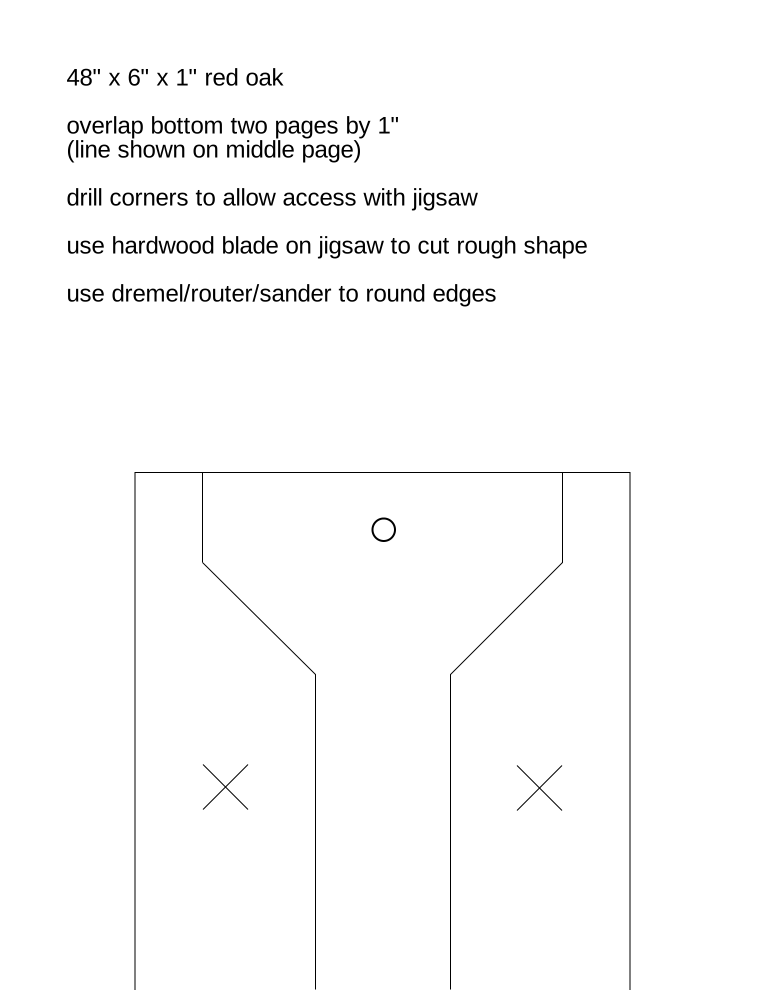
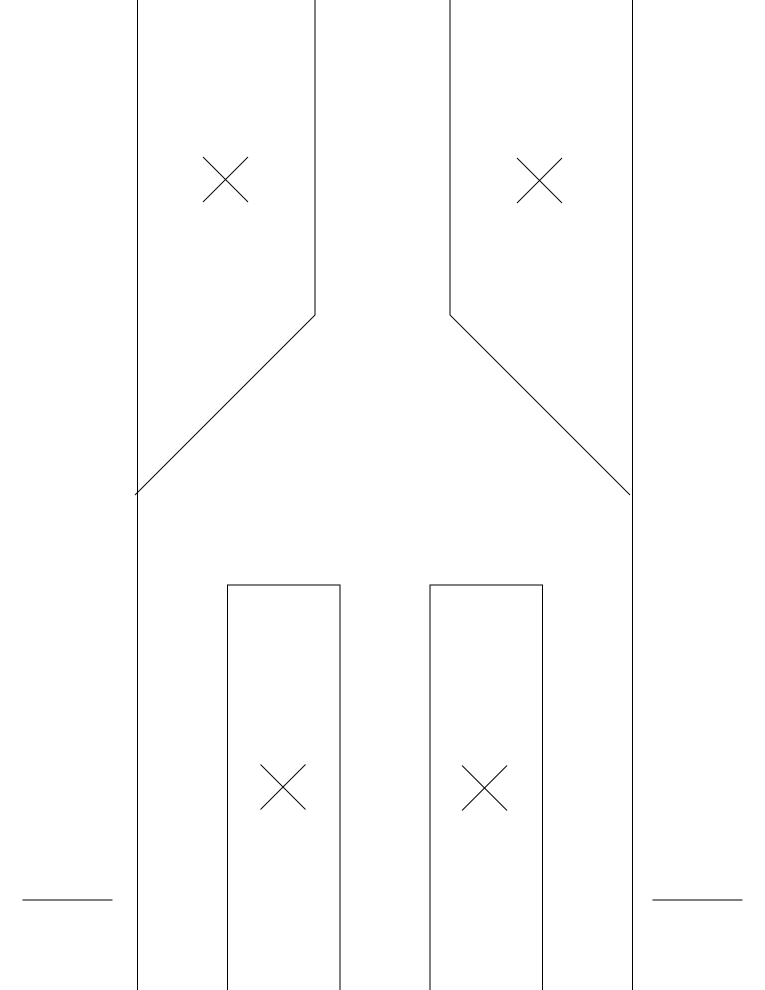
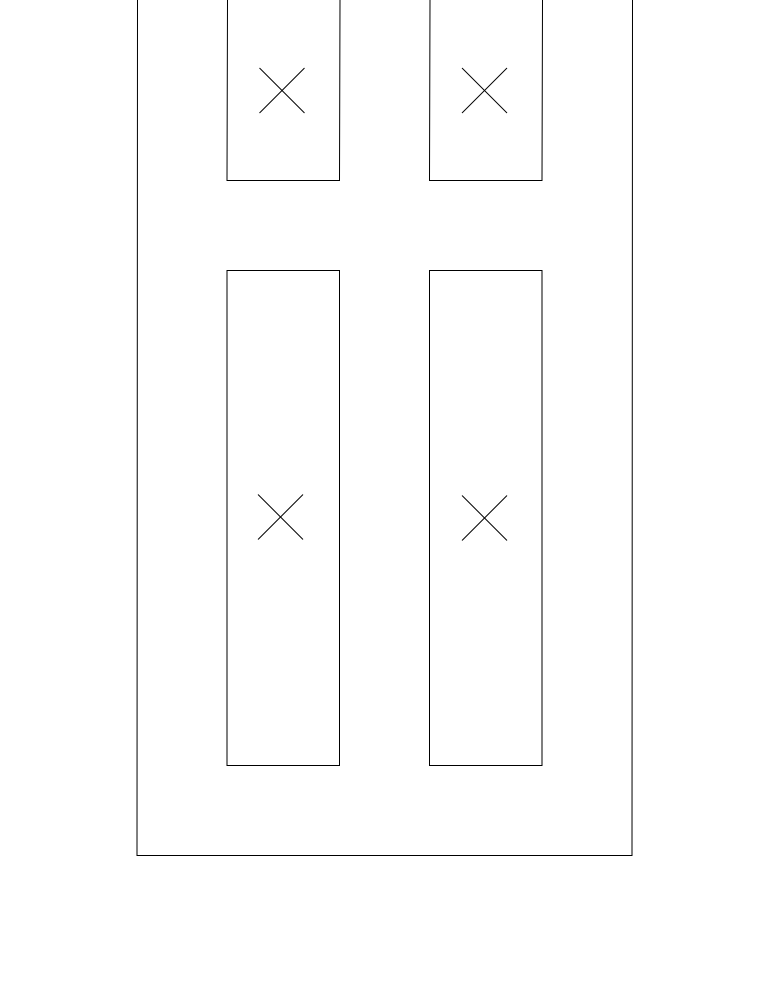
i decided on a rough design and did a full-size drawing on paper, making a few adjustments until i thought i had what i wanted. (i’m going to add a printable PDF here eventually in case anyone would like to do the same. if you’re interested, drop me an email and i can give you the measurements or something). Edit: here they are, just make sure you print them at the original size and don’t use any scaling:

unfortunately, i didn’t think to grab my camera until i was done making the paddle, but i still had the scrap pieces around so i took a few photos to give you the rough idea.

the whole thing, layed out as before i started cutting.

a closeup of the bottom end of the paddle. initially i made large holes at each corner. for the inner holes you can see that i tried to make two of them beside each other, but it was quite a pain in the ass, and really unnecessary. the large holes were not really necessary either. i made smaller 1/4″ holes in the opposite corner of each section and it was enough to get my jigsaw in and around the corner.

the top end of the paddle, with a nice handle that makes it easy to control and a hole so that i can hang it up when not in use.

closeup of the finished bottom end of the paddle.

and the top.

the finished paddle hanging on the wall in my garage, waiting for the next brew day.

the basic procedure i used was to draw the design out on the wood, drill pilot holes in the corners (5/8″ for the big ones, 1/4″ for the small ones), then use a jigsaw with a blade designed for hardwood to cutout the four center pieces and the two sides. once i had the basic shape cut out i tried using my dremel to do some rough shaping and sanding. i found that the small tool size made it difficult to get a nice even finish to the edges, so i switched to a belt sander. the belt sander made quick work of rounding out all the edges, but didn’t work very well in the corners. i went back to the dremel to clean up the edges and the parts where the beld sander couldn’t reach (like the four inner holes). i used a foam sanding block to smooth everything out, then switched to a piece of find grit sandpaper to finish things off, concentrating on making sure the handle was nice and smooth.

we’ve used it for two brew days so far, and it’s working wonderfully. i’m quite happy with it and have completely forgotten about my initial search for a stainless paddle.

raising the edmund fitzgerald

an easter weekend brew day for the biergotter crew, even if there were only two of us present today. that’s ok, the beer goes farther when you only split it two ways! :)

eric and i tossed around a bunch of ideas about what to brew, but last weekend when he said ‘hey, we should do a clone of ed fitz’, (referring to the fantastic Edmund Fitzgerald porter by the Great Lakes Brewing Co) i was sold. porters are my favourite style, and ed fitz is one of my all-time favourite beers, so it didn’t take much convincing. i found some info about the ingredients and what was supposed to be a close recipe, and went shopping. hit the usual wine and beer factory for some yeast, hops, and grain on tuesday and we were set.

today also gave me a chance to try out some new hardware: my shiny new barley crusher grain mill, the deep-discount stir plate and glassware, and a nice oak mash paddle that i made this week (post on that to follow). the barley crusher was kickass, and tore through the grain in no time (even with cranking it by hand). crush looked great with the factory setting and efficiency is right around where i expected. the stir plate led to a boatload of really happy yeast. and the paddle worked out even better than i thought it would.

also present for part of today were a couple of guests, rob and taavi. both are interested in learning more about brewing, so i invited them to drop by and see how we do things.

on with the photos!

two of the stars of the show: the stir plate and barley crusher. smacked the yeast thursday morning and transferred it into a starter thursday night just before taking this photo.

mmmm, portery goodness. nice color, even on the head. this is the grain during the saccarification rest.

rob (left) and eric (right), consuming some much-needed coffee. note the handle of the mash paddle sticking out of the keg on the left. more photos of it in a second.

heating it up for mash out.

eric stirring the mash.

closer view of the mash paddle, made from a piece of red oak. it worked much better than the broom handle we’ve been using.

a couple quality shots of me cleaning out the tun, transferring the spent grain to a clear garbage bag so it can go out with our organic recycling. eric needs a little more practice with the camera (although he’d probably blame his hangover).

not one, not two, but THREE shots of the hot liquor on its way towards the boil. i think this was about when rob and eric said it’d be boiling “anytime now”. it actually started boiling about 45minutes later. the wind seemed to make things heat up kind of slowly, and led to a larger boil off than we expected. more on that later.

so the barley crusher is supposed to fit nicely on top of a 5 gallon pail. lets just say that it doesn’t work quite as well on a 6.5 gallon pail. started trying to turn the crank and promptly flipped the barely crusher, spilling about a half pound of pale malt all over the garage floor. oh well, we figured our efficiency would make up for it (and it did). this won’t be an issue once i get around to motorizing it…

here we have rob skimming the hot break. mmm, skum.

eric and taavi monitoring the first carboy as it fills.

me, keeping an eye on the racking cane and trying to keep it out of the sludge at the bottom of the kettle. can you tell porter makes me happy?

two shots of the starter, just prior to pitching. stepped it up on friday, so by pitching time it was full of nice, happy yeast.

the two carboys after about 90 seconds of pure oxygen from the 0.5micron diffusion stone and pitching the yeast. fitted with blowoffs and ready for what i expect to be a fast and vigorous ferment.

when the day was done we had 10.5 gallons of wort at 1.075. woops! we were aiming for 1.058 from 80% efficiency (which should have gave us about 5.8-6.0%abv), but actually hit 81%. pre-boil we had about 13.2 gallons at 1.053, which looked fine, but we lost almost 3 gallons during the 90 minute boil. so that put us at 1.075, which will likely put it closer to 7.5%abv. oh well, if it turns out anywhere close to ed fitz we’ll be pretty darn happy.

oh yeah, here’s the recipe. enjoy!

first brew day of 2006

it feels like ages since our last brew day in november, so at the beginning of the week when the weather man started talking about saturday being unusually warm and the only sunny day all week, my interest was piqued. i thought it was too good to be true, but as i checked each day they were consistently saying the same thing: warm and sunny on saturday, rain the rest of the week. by thurdsay it was decided: saturday would be the first brew day of 2006!

for a while now i’ve been curious to try a solo brew day. so far all the brewing i’ve done had been with one or more of the other biergotter guys, but i figured at some point the time would come when i’d want to brew a batch and nobody else was available. so i figured i’d try my luck with a single 5 gallon batch. with most of our equipment stored at my place, i had everything i knew i’d be set in that department. i’ve got a small stock of grain, so i figured i’d have just about everything i’d need for a batch of this size. i had a bit of hops, but not enough to really do anything with. yeast would be a problem, but i could make a run to the wine and beer factory and see what they had in stock. i know they usually stock Wyeast liquid yeast, and worst case i could always grab some dry yeast and give that a whirl. we usually use White Labs liquid yeast, but i’ve heard many great reviews of the Wyeast stuff from the guys in the homebrew forum on Beer Advocate.

when i arrived at the shop thursday evening the (new) owner was very apologetic because his yeast selection was limited, and the most recent stuff had expiry dates of nov 30th, 2005. however, he said he’d give me a discount because of this. i flipped through the selection and was able to find two packages of wyeast 1968, London ESB ale yeast, both with the nov 30th expiration. i knew the rule of thumb for Wyeast was to allow an extra day of swelling for each month past the expiration date, but since i was planning to brew on saturday i didn’t want to take a chance of having a dud. so i bought both packages and he only charged me for one! great deal. i grabbed some hops and a pound of carapils and headed for home.

when i got home i smacked both packs (making sure that the nutrient pouch had burst) and stuck them in the pocket of my sweatshirt to incubate. within a couple hours they were visibly swelling, and by the time i went to bed they were both about an inch thick. when i woke up friday morning it looked like they were going to burst at any moment, so i quickly boiled up some DME, cooled it, and pitched both packs in. i gave it a really good shake to make sure it was aerated well. no turning back now! after work i got the garage setup for brew day and went to bed early, excited for the brew day.

saturday morning i woke up around 8:30am, grabbed some breakfast, and headed outside to get started at about 9:30. it felt odd only weighing out a total of 8.5 pounds of grain, especially after stuff like our imperial stout that was 45 pounds for a 10 gallon batch (about triple the size of this one). oh yeah, this batch is an attempt at a “small” beer, an english pale ale that should finish at about 4% ABV. In the last 6 month we’ve done lots of “big” beers (high gravity/high alcohol). we did try an english bitter in october, but we weren’t all that happy with how it turned out. it was ok, especially considering it was basically “free” (second runnings from our DIPA), but with it being about half DME it just didn’t have the malt backbone to stand up at that gravity. This time it was all grain, with Maris Otter as the base malt, so i figured it’d be alot better off. Also used an english yeast rather than the more generic White Labs California Ale yeast, which should make a big difference.

overall the day went pretty smoothly. no real problems to report. hit all my temps ok. probably the biggest “problem” was that i hit 85% efficiency, so instead of being around 1.043ish it ended up being 1.050. i had accounted for it still being in the same area if i got as high as 80% efficiency (which we have on several occasions), but hitting 85% threw it off a bit. oh well, worse things could happen…

so by 5pm i was done with cleanup and the wort had been aerated and the yeast was pitched. hopefully it’ll be rockin’ along in no time.

on with the photos!

8.5 pounds of grain, crushed and ready.

after the first infusion (1qt per pound). time for the 30 min protein rest at 122F/50C.

after the second infusion (0.5qt per pound), i wasn’t quite up to the 150F i wanted for my mash, so i had to throw it on the heat to bring it up to temp.

checking the temp… not quite there yet.

stir stir stir. don’t want to overshoot my target temperature.

after the 1 hour sacch. rest, it’s time to bring it up to 170F for mash out.

here’s our bucket tun filled and ready for sparge. the bucket works great for up to a 15 pound grain bill, so it was more than enough to handle the 8.5 pounds for this batch. no need to use the cooler tun (which is in the background of this photo).

done with the vourlaf, so time to start collecting wort.

the usual tin foil top cover on the tun. poke some holes and you’ll be sure to avoid any channelling or over-compacting the grain bed.

now the pot is on for the boil. notice the pot and strainer for skimming the hot break as we approach the boil.

the pre-boil gravity sample, with a shiny new hydrometer. i put the old one in the sample, and about a second later i saw a stream of air bubbles coming up from the bottom of the hydrometer. i quickly pulled it out and noticed a small crack in the bottom. fortunately, jenn was nice enough to run over to the local wine shop and grab me a new hydrometer while i monitored the boiling wort. the hydrometer read 1.034 at 93F, which works out to 1.039. with 7 gallons of wort collected, that means i hit 85% efficiency. nice!

wort chiller in action.

the nicely cooled wort going into the carboy.

the carboy down in the basement after a minute of pure oxygen. that’ll make the yeast nice and happy.

speaking of yeast, here’s the stars of the show. i decanted off most of the spent starter wort this afternoon, then took about a quart of wort from the pot and boiled it for about 15min, then cooled it and added it to the starter. by pitching time the yeast was happy and ready to conquer some wort, even if it’s a small one.

here’s the beer-in-training after aeration and pitching the starter. it’s got lots of headspace, but i fitted it with a blowoff tube anyway.

so there it is. my first solo brew day was a success. lets hope the resulting beer turns out well!

cutting a keg kettle

I’ve seen descriptions of how to cut the top off a keg for use as a brew kettle, but never one with lots of detail or photos of the process, so when i made our last one back in november i took photos along the way. enjoy.

here’s the uncut keg with the line drawn for cutting. Take a piece of string and loop it around the center post in the keg. then grab a sharpie and put it in the other end of the loop. rotate around the post to make a nice circle for cutting. We made the hole the same size as the top on one of our 5 gallon pots, which turned out to be 12 inches, so that we can use the lid on the keg too.

to do the cutting we’ve been using my dremel with fiberglass reinforced cutting wheels. The regular disks just disintegrate too easy. The fiberglass onces will still wear down if you try to go too quickly, but with patience you can get the keg cut with only a couple disks.

starting the first pass. Don’t try to go all the way through right away or you’ll burn through the cutting disks in no time. make a first pass about half way through to “score” the cut first. you can see the cut starting towards the bottom and going about 1/4 of the way around clockwise.

bit closer shot. you can kind of see that i’m not going the whole way through yet.

now i’ve gone the whole way around and i’m starting the second pass, cutting the whole way through now.

same thing a little closer.

this one shows that i’m almost done, just a little left at the bottom to finish.

now that the hole has been cut, it’s pretty jagged and sharp around the edges. switch to a sanding wheel and clean that up so that nobody gets hurt.

the finished product after sanding the edges down. you can see all the bits of metal and some water in the bottom. One thing that i didn’t do when i cut the keg is fill it mostly full of water. i’ve heard that this greatly helps deaden the sound of the dremel, which is pretty damn loud. i’ll know that for the next time i need to cut a keg…

so that’s it. all it needs is a good washing and it’s ready to be used as a kettle. you can optionally install things like thermometers and drainage valves, but we just use them like this and siphon liquids out.

frozen brewing

Yesterday was another brew day for the biergotter crew, and an interesting one it was. The day got off to a bit of a rocky start. we were planning to get started around 9am, and at 8:30 i got a call from Rob. he had slept through his alarm and was still in waterloo (approx 2 hours away), so he was going to be late. since he was picking Tim up on the way, that left Jayc and i to get things rolling in their absence. with two batches planned for the day, we knew it was going to be a long one. jay and i finalized the details of the recipes for the day while watching friday’s episode of aqua teen hunger force, and started to work.

as it turned out, tim and rob got to within 5min of my house, but got stopped by a parade. apparently i was smack in the middle of the parade route that bounded the major roads in all 4 directions. by the time they managed to get through that and find there way to my place they were nearly 3 hours late. we told rob that the moral of the story was to wake up when the alarm went off so that you didn’t hit the parade, but he was still unhappy :)

by that point we had the first batch, a Rochefort 10 clone, well underway. unfortunately, since we were kept kind of busy with this we didn’t really start working on the other batch, a badass imperial stout, until after rob and tim arrived. we finished grinding the grain for the stout around 2pm. by this point the Rochefort was mostly finished, so we were free to focus our attention on this batch.

for the stout we had big ideas. until now we’ve been limited to a 30 pound maximum for our grain bill due to the size of our cooler tun. this works out great for 5 gallon batches, but is limiting when working on a 10 gallon batch of something with high gravity. we’ve used sugar and dry malt extract in the past to boost up gravity, but this time we wanted to do it purely with grain. we also have an older smaller tun in a bucket that holds about 15 pounds of grain, so we decided to go for a 45 pound batch and just use both tuns. we figured the easiest way to do this was to treat the beer as two separate batches, splitting the grain bill so that 2/3 of the pale malt went into each batch, and then just split up the specialty grains between them. we decided that to give the impy a little more body and malty character we would use the smaller 15# batch and mash it higher. we also thought that instead of just running both tuns into the kettle it would be more exciting to do it “doble” style, running the liquor from the “high” tun down into the “low” one (see photos below).

the grain bill was split so the “low” mash was 21# of 2 row along with the brown, biscuit, and victory malts (total 30#). the “high” mash was the remaining 10.5# of 2 row and the chocolate, black patent, crystal, and roasted barley. the “low” batch was mashed at 152F, the “high” batch at 158F. The runnings from the “high” mash flowed into the “low” mash. sparge water was added to the “high” mash and it worked its way down into the “low” tun. about 14.75 gallons of wort at a gravity of 1.083 was collected. At this point the runnings from the “low” tun were still fairly high, so we gathered an additional 2 gallons of wort at a gravity of 1.050. The extra 2 gallons was boiled down until less than 0.5 gallon remained. we tried to take a gravity of this “magic elixer” and found that our hydrometer only went up to 1.170. At 120F, that works out to 1.180, so we know it was at least that. we took 1 quart of this and added it to the main wort at flameout. even with a 90 min boil on the wort we only boild off about 2 gallons, which yielded 12 gallons going into primary, with the remaining gallon donated to the beer gods…

Everyone brought beer to sample. on hand were our most recent ipa (brewed in september), our scottish ale (brewed in june), zywiec porter, bell’s 20th anniversary ale, dark horse crooked tree ipa (which makes me think of pavement), ommegang hennepin ale, stoudt’s double ipa, stoudt’s fat dog imperial oatmeal stout, and stoudt’s scarlet lady ale esb. an interesting mix of beer that we all enjoyed.

lots of new records for us today:
-latest brew day (nov 26)
-coldest brew day (-3C)
-longest brew day (9am-2am)
-largest grain bill (45#)
-highest gravity all grain (1.100)
-highest yearly brew total (~75 gallons)

on with the photos…

yes, it’s winter here in the toronto area, with several inches of snow falling over the last few days. it was fairly cold (slightly below freezing), but there was no wind so the weather wasn’t too bad for brewing. first infusion of water for the Rochefort heating up on the burner.

jay grinding the grain for the rochefort clone.

the 15# grain bill waiting for its first infusion.

i overshot the temp on the first infusion, so took advantage of the cold weather to help cool it down. this wasn’t happening quite fast enough so i ended up pulling a couple quarts and replacing it with cold water. this brought us right where we wanted. this was our coldest brew day, and because the grain and equipment was all pretty cold we had to adjust for this, going with slightly higher temps for each infusion in order to make sure we hit the correct temperature. the protein rests were fine, but we needed some heating to bring us up to saccharification temps. we also had to keep a closer eye on our temperatures, giving a bit of heat around 40 minutes into the sacc. rest.

the bag of maris otter waiting for use in the stout. our usual 2-row is a bit thin and unexciting, so we decided to find some maris otter for this batch. as it turned out, it’s even cheaper than what we’re currently useing. we have to head over to detroit to get it, but considering most of us end up in windsor fairly regularly that’s not a problem. we’ll be using alot more of this in the future.

heating up the rochefort to mash out temperature.

jay stirring the pot, and the arrival of rob (on the left) and tim (right).

we didn’t waste any time putting them to work. here’s rob working on the grind for the stout. can you tell he’s injoying it?

here’s the rochefort approaching boil and tim skimming the skum.

the grain for the stout, crushed and ready. the “low” one on the left, and the “high” on the right.

the rochefort in full boil.

tim checking the temps for one of the first infusion on the stout.

we moved the burners into the garage to help keep us warm. my burner is right inside as it doesn’t get nearly as hot as jay’s jet burner. we kept his closer to the door as it gets pretty hot.

rob’s really excited about the stout. here you see him checking on them. sort of looks like he’s trying to guard them from everyone else and keep them for himself…

mmmm…tasty. can you tell which one has all the roasted grains?

chiller ready for action. had to bring the hoses in the house for a while to thaw them out before we could do this. then we left the chiller sitting out for a few hours and it turned into a rock, so we had to bring it inside to thaw out too.

the tuns setup and waiting. the “high” tun was also elevated with respect to the “low” one, so it’s more than just mash temp.

mashing out on the “low” pot.

the tuns filled and waiting. check out how black the flow from the “high” tun is.

yep, light isn’t even getting through it. hopefully the final product will be this impressive!

that’s me (russ) dumping the last of the mash into the cooler.

jay prepping the tinfoil on top of the ‘high’ tun. think he’s having fun?

the runnings from the “high” tun quickly turned the “low” one black.

tasty hot black liquor.

can’t get enough pics of this setup. the flow from the “high” tun stayed super black all the way to the end, and it didn’t take long before the “low” tun looked the same.

tim on skimming duty again. we had to be really careful with this one as it’s the fullest we’ve ever pushed our kettle. at just shy of 15 gallons, there wasn’t much headspace if it decided to boil over. fortunately after skimming most of the hot break we didn’t have much trouble.

by the time we got the imperial stout up to a boil it was after 10pm. it’d been dark for hours, and especially with the steam we had to use a flashlight to see what we were doing. here we see jay helping tim see the skum for skimming.

this is the pot of what we were calling the “magic elixer”. the final 2 gallons of runnings were put on to boil, and probably spent about 2 hours boiling while the main wort got up to and ran its 90 minute boil. the result was under a half gallon of super sweet liquor. it tasted alot like molasses, with strong hints of caramel and licorice.

we decided to use a quart of the elixer, adding it to the main wort at flame out.

frost on the propane tank…think it was cold?

so when the day was done it was 2am and we had 12 gallons of imperial stout and 6 gallons of our rochefort 10 clone. all were aerated with oxygen and a 0.5micron stone for about a minute, then again after 10 and 14 hours. the plan is to dissolve a pound of candi sugar and add it to the primary after a few days, then add the second pound a few days later.

stay tuned for fermentation photos…

update: nov 28/2005, 8:30pm

just took some photos of the fermentataion, and they’re both looking great!

this is the rochefort clone. it’s in an extra-large carboy, so there’s plenty of head space. even so, there’s a serious layer of krausen on top.

damn that impy looks fine. it’s blowing off like mad and making a mess in the pot. good use for the aluminum pot that came with my “turkey fryer” burner.

brewing the club seasonal

another brew day for the biergotter crew. this time around it was our “club seasonal”, a spiced imperial porter for the holidays. on hand for today’s festivities were tim, jayc, jayw, eric, and me (russ). Tim’s brother-in-law also dropped by for a bit to observe the magic that is all grain brewing.

we had a keg of our mild english bitter on tap for the day. This kept things interesting as the hops kept clogging up the works. we’d fill a pitcher until it came to a stop, then reverse the disconnects so we could “blow out” the outlet with co2, and keep going until it clogged again. by the time we got half way down the keg it was pretty much stuck and there wasn’t much we could do to get it moving. so we popped the keg open and just poured it through a strainer and into pitchers. it was supposed to be lightly carbonated, so this worked out ok. next time we’ll be sure to bag the hops before adding to the keg…small oversight in our first attempt at keg hopping.

with several of the biergotter crew at halloween parties the night before, tim and i volunteered to get things started early and let the other guys arrive a bit later. unfortunately, due to commitments with the Kitchener-Waterloo Little Theatre rob wasn’t able to join us for the day. he’s been pretty busy with the theatre rebuild project and hasn’t been able to take part in much brewing lately, but he tells us that he’ll soon be rejoining us for some brewing fun. we still managed to arrange a time when jayw would be up visiting from windsor, so we went ahead with everyone else.

on to the photos!

“wheezy”, the biergotter dog. actually, her name is nico, but she does wheeze alot. she mostly just layed around in the sun, but did try to take on several dogs approximately 20 times her size. fortunately we kept an eye on her and didn’t let her get into too much trouble.

stirring up the mash to make sure the temp is up to saccharification temp of 155-156F.

jayc stirring the mash, eric drinking some of the bitter, jayw in his fine pirate hat also sampling the bitter, and tim striking a pose.

stir stir stir. still using a wood broomstick while we continue to search for a nice stainless paddle.

bringing the kettle up to 170F for mash out. pretty excellent color. guess that’s what you get with a pound of black patent and a pound and a half of chocolate malt…

after vorlauf we started to collect some wonderfully black porter. well, i guess at this point it’s still just “porter in training”.

the tun full of 31 pounds of grainy goodness. that’s jayc in the background keeping an eye on the flow.

still going. we got pretty close to a stuck sparge on this one. we had the flow going nice and slow, but it was gradually getting slower. even running wide open it was slowing to a trickle. we checked and found that the grain bed had really compacted down, so we stopped the sparge and gently stirred the mash, careful not to knock the manifold out. after another quick vorlauf we got it going again. it continued to flow slowly, but it was steady so we let it go. eventually we had 14 gallons of sweet tasty wort at a pre-boil gravity of 1.071.

standing around and waiting for the sparge. it took eric 5 tries to get a decent photo, but eventually he managed this one. from left to right we have tim, jayc, me (russ), and jayw. yar.

time to fire up the burner and get the boil going.

jayc skimming the hot break and eric showing off the bitter.

yay skum skimmin’. since we started doing this we’ve never had a boil over. highly recommended!

half way through the boil. can see the deep brown/green color of the head and first hop addition.

the jays. in case you were wondering, jayw was wearing the fine pirate hat from the costume that he wore to a halloween party the night before. he went as a priest from the church of the flying spagetti monster, wearing the appropriate full pirate regalia. he didn’t go to bed until 4am, and then after a daylight savings mishap was awake at 7am. he was feeling a little rough, so we just kept filling him with bitter.

since it today is halloween we had some candy and party favours (prepared by jenn) on hand for the brew day. this one shows jayc trying out his new flashlight. oooh, frightening cat!

jayw had a frightening glowing red bat.

ooohh! scary!

jay with the bat, tim with his red skull necklace.

eric also testing out his flashlight. i think there’s supposed to be two visible flashlights showing cats, but it’s pretty hard to see…

eric enjoyed the bitter a little too much. i suppose it didn’t help that we kept telling everyone who wasn’t driving that they needed to finish the keg before they could leave. by the end of the night we were taking bets that he was going to be sick in jayc’s car on the way home…

so the day went pretty smoothly, and when all was cleaned up we had about 11 gallons of 1.077 wort, lightly spiced and going into fermentation with two huge starters of white labs irish ale yeast. we’re hoping to have half of this in bottles, and the other half on tap for new years eve!

fermentation update

24 hour update…

the two DIPA‘s at the 24 hour mark. fermenting away happily.

the mild english bitter. still slow, but it’s going…

beers we brewed up a couple weeks ago. the barleywine on the left still chugging along, and IPA on the right.

now we see the the bitter at the 48 hour mark, foaming all over and making a mess. after a little dry hopping with some fuggles, this one will be on tap when we brew our club seasonal oct 30th.

the two double IPAs fermenting up a storm.

barleywine and ipa still happy.